
My France Road Trip Began When the City Booted Up at 9 P.M.
What Toulouse taught me about rhythm, travel, and not over-planning everything.

France is already here.
Yesterday, we crossed from rehearsal into the main feature: Barcelona Sants, the train to Perpignan, the Sixt rental counter, and then the road to Toulouse. The trip was no longer an idea on paper. It had become weather, luggage, highway air, water, Coca-Cola, and the quiet pleasure of a transfer day working as designed.
A good itinerary is not a cage.
It gives freedom both a map and margin.
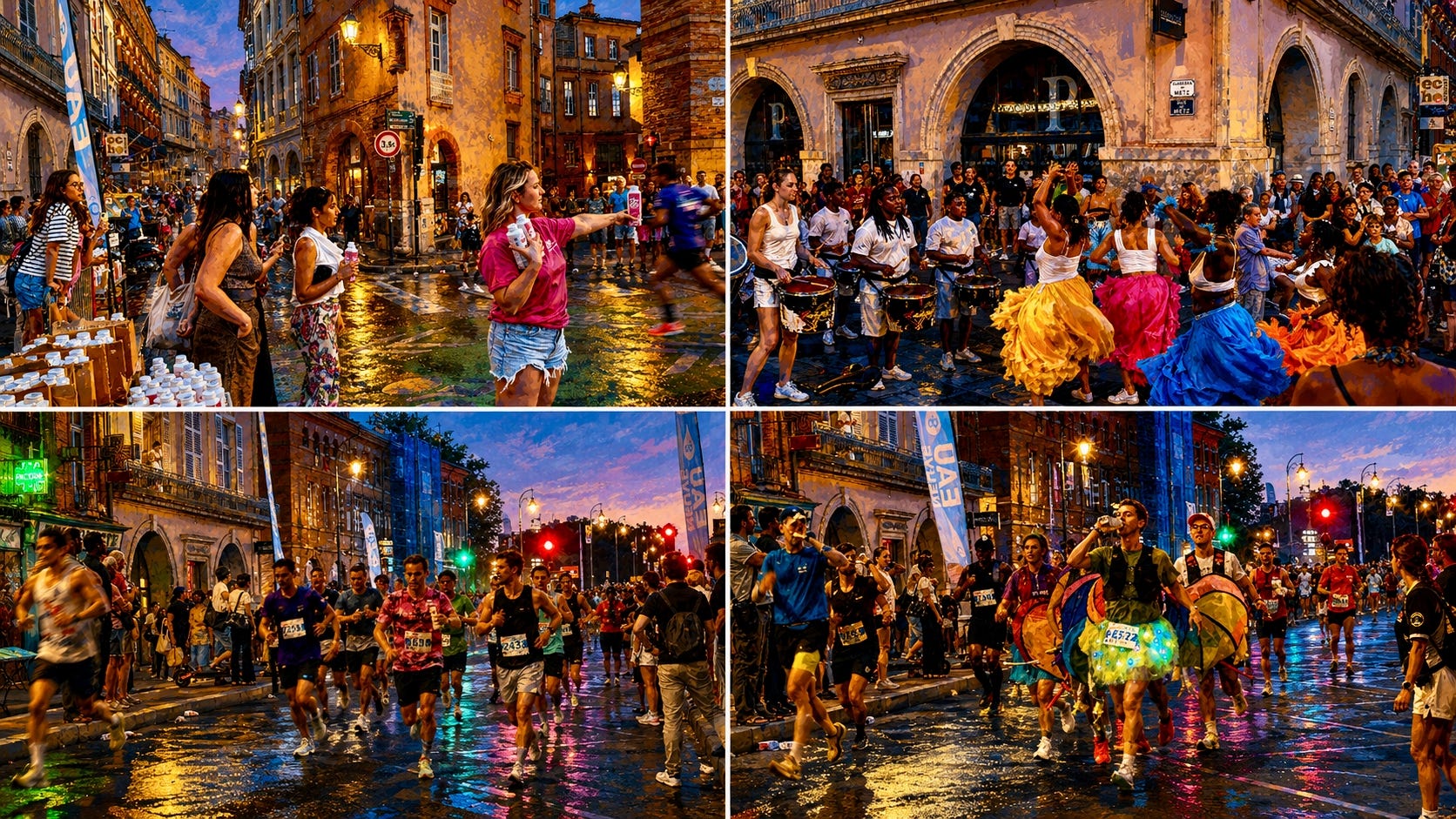
The City Booted Up at 9pm
Last night, Toulouse did not sleep.
More precisely, at nine o’clock, the city suddenly booted up.
This was not the quiet, elegant French evening walk one imagines from a perfume commercial, where everyone appears to have just applied a tasteful woody fragrance and is now prepared to stroll through life in slow motion.
This was a warm-blooded civic event: lively, a little wild, and somehow exactly right.
Drumbeats bounced between the red-brick buildings. The music shook the street awake, confident enough not to ask anyone’s permission. Volunteers stood along the route with package of water, as if guarding a sacred supply line for public happiness.
Sweat, laughter, breath, applause, and that strange seriousness people carry when they willingly enter joy all poured into the city center.
We thought we were simply walking back to the hotel.
Instead, we stepped into a moving theater.
The sun had already gone down late, but Toulouse seemed newly awake. That summer-evening light, somewhere between day and night, unwilling to clock out on time, made everything feel slightly unreal. Streets that had looked ordinary in the afternoon suddenly changed identity after 9pm. Intersections became stages. Metal barriers became balconies. Sidewalks became front-row seats. A route became a river.
The music was almost too loud.
That was why it worked.
The scene was loud, warm, and completely uninterested in museum-style refinement. No one was whispering, “Please keep a proper distance from the exhibit.” The purpose was simple: lift people up. And it did.
The runners moved. The volunteers moved. The crowd moved. Even those of us who had not registered, stretched properly, hydrated scientifically, or made any responsible promise to athletic life were pulled into the current.
At first, we were spectators.
A few minutes later, that word no longer felt accurate.
A spectator stands outside the event. But last night, where was the outside? The drums crossed the boundary first. Then the music. Then the applause. Then the runners’ faces. Then the focus of volunteers handing out water. Every package looked important because, in that moment, every drink of water was important.
We did not run the race.
But somewhere inside the body, something had been lightly switched on.
This is one of the most charming surprises of public life: participation does not always require a registration form. Sometimes you participate by watching well. By clapping. By stopping. By allowing a city’s energy to enter you before you have time to defend yourself against it.
Toulouse was not merely hosting us last night.
It added us, without warning, to the city group chat.
When we returned to the hotel after 10:30pm, we were tired, but not in the usual tourist way. Not the kind of tired that comes from being beaten senseless by a checklist of attractions. This was the fatigue of having been touched by a city and still carrying some of its electricity.
Toulouse did not show us a monument.
It let us touch its pulse.
The Morning After
This morning, we woke after 10:15.
By then, the official itinerary had basically lost administrative power.
Strangely, that was when the day began to make sense.
In every real journey, there comes a moment when the printed plan stops being commander-in-chief and becomes a friendly suggestion with too much confidence. Last night’s race had done its work. It gave us energy, yes, but it also used up a meaningful portion of our battery. So today could not begin with “conquer the city.” It had to begin with “admit we are human.”
The body filed its report first.
Last night mattered.
Before the mind could prepare a respectable explanation, the body had already pressed the “sleep a little longer” button.
So waking after 10 was not a failure of discipline. It was evidence. Something had reached us. The body is often more honest than the mind. While the mind was still organizing field notes, the body already knew the answer.
My wife wanted to go to Marché Cristal, so we followed the living itinerary instead of the printed one. That sounds like a small decision, but it contains half the wisdom of travel.
We went to the market and borrowed a little warmth from ordinary life. We passed by Victor Hugo, considered lunch, adjusted course, and eventually had a nice brunch. Then we went up to the rooftop at Galeries Lafayette and let Toulouse become clear from above: pink roofs, old streets, soft light, and a city that had first shown us its night pulse before slowly unfolding its daytime order.
That rooftop was not a grand campaign of sightseeing.
But it was enough.
“Enough” is a seriously underrated travel word.
It is also a seriously underrated life word.
Enough Is a Travel Word
In the afternoon, the day split beautifully into two tracks.
I returned to the hotel before 2pm, rested, napped, and slowly found my writing state again. My wife stayed at Galeries Lafayette for shopping, then later wanted to go to Oysho. That, too, belonged to the rhythm of the day.
Mature travel does not mean two people are bundled together every minute like a promotional package. Sometimes companionship means walking side by side. Sometimes it means moving on parallel tracks.
She shopped.
I observed.
We both recovered.
That nap mattered. It turned heat, fatigue, and last night’s electrical excitement into reflection. It returned the writer to me.
A nap is not surrender.
A nap is tuning the inner instrument.
We do not keep seeing simply by forcing our eyes open. Often, we keep seeing because we know when to close them.
That was where Toulouse, quite unexpectedly, became my July 4 teacher.
Freedom Needs Rhythm
Today is America’s 250th birthday.
On this birthday, I am not in Washington, New York, Boston, or Philadelphia. I am in Toulouse — a French city made of red brick, markets, aviation, river light, late-night running, local wine, and a football match that does not begin until 11pm.
Perhaps that distance helps.
Sometimes you need to stand in the city of an old ally to see your chosen country more clearly.
America has always loved movement: departure, expansion, reinvention, the open road, the next frontier, the next version of the self. I understand that grammar deeply. Much of my own life has been lived inside it.
But on America’s 250th birthday, France gave me another lesson.
Not a lesson in stopping forever.
Not the fantasy that doing nothing automatically becomes wisdom. Sometimes doing nothing is simply doing nothing, even if accompanied by a small espresso.
The lesson was more practical, more human, and harder to practice:
Freedom needs rhythm.
Without rhythm, freedom becomes exhaustion.
Without form, movement becomes noise.
Without pause, even adventure loses meaning.
Freedom with Choreography
Last night’s race was wild, but it was not chaos.
It had a route, volunteers, timing, music, water stations, police presence, cheering crowds, and a city willing to lend its streets to shared motion.
It was freedom with choreography.
That is why it felt so alive.
The runners were not merely exercising. They were presenting themselves in public: as bodies in motion, as citizens moving in the same rhythm, as ordinary people briefly lifted by the city. The volunteers were not just handling logistics. They were guardians of the human tempo. The spectators were not passive consumers of excitement. We began as witnesses, and then somehow became participants.
A city square is not empty space.
It is a civic stage.
A street is not only a traffic channel.
It can become a river of public energy.
Beauty is not decoration.
Beauty is infrastructure.
Shade, fountains, markets, rooftops, meals, sidewalks, music, volunteers, and the tender delay of summer evening light: these things shape human behavior. They make certain forms of life possible.
By American KPI standards, today was not especially optimized.
We woke late. We changed the plan. We did not maximize the number of attractions. We returned to the hotel in the afternoon. It was hot, so we allowed the weather to participate in decision-making. Shopping, brunch, rooftop views, and rest all became part of the day.
But the day did not become smaller.
It became deeper.
This is one of the quiet reminders travel gives you after the first half of life: the point is no longer to prove you can cover everything. The point is whether you remain open enough to receive what the day is actually trying to give you.
Yesterday, Toulouse revealed itself through a night race.
Today, it revealed itself through recovery.
Both were celebrations.
Dinner Before the Tribute
By evening, we were ready to re-enter the city, but at the right scale.
Dinner at La Braisière gave the day its second Toulouse stamp. Last night had been Le Colombier, cassoulet, and a stronger sense of tradition. Tonight was different: more relaxed, more grounded, less formal, more everyday. Local red wine, grilled food, old streets, warm air, and a restaurant rooted in the older arteries of Toulouse.
The bottle of Fronton, Plaisance Penavayre, suited the day: local, modest, slightly chilled, right for the heat.
Not grand.
Not theatrical.
Just right.
Many things that are “just right” carry a quiet dignity.
After dinner, we did something that looked small on the map but felt important on the ground.
We did not chase another attraction.
We returned to the place where last night’s surprise had happened.
The Route Marked by Memory
The same corners were there.
The same crossings.
The same streetlights.
The same warm Toulouse air.
But the drums were gone. The runners were gone. The volunteers were gone. The water stations, the applause, the moving river of bodies, all of it had disappeared back into ordinary city life.
That was exactly why the walk mattered.
Last night, the street belonged to motion.
Tonight, it belonged to memory.
We walked through the same area again. Last night, the music platform and dancing crowd had turned an ordinary intersection into civic theater. There had been runners, volunteers, sound, sweat, and applause. Tonight, it had mostly returned to normal: traffic lights, bicycles, shop windows, people heading home, the city quietly becoming itself again.
That contrast was the tribute.
We did not honor the night by trying to repeat it.
We honored it by walking again through its trace.
Real spectacle cannot be copied.
It can only be remembered well.
That is why the walk back to the hotel mattered. It was not just navigation. It was not merely following the blue dot from point A to point B. It felt like a small pilgrimage.
We stood again where the city had lifted us.
The route was no longer marked by runners.
It was marked by memory.
That sentence became the quiet center of the day.
America at 250, Received from Toulouse
On America’s 250th birthday, the lesson I received did not come from a monument. It came from a schedule that quietly surrendered.
I learned something from a French city that knew how to turn a street race into civic theater.
I learned something from volunteers passing water in the dark.
I learned something from waking late without guilt.
I learned something from a market instead of a checklist, brunch instead of forced sightseeing, a rooftop instead of depletion, a nap instead of performance, dinner instead of conquest, and a walk home that became an act of gratitude.
This is how we celebrated America’s birthday.
Not with fireworks.
Not with speeches.
Not by working hard to manufacture significance.
We celebrated by observing what freedom looks like when it has rhythm.
A nation, like a person, cannot live only by acceleration. It needs rituals of energy and spaces of rest. It needs public stages where people remember they are not only private lives moving separately through the day, but part of a shared performance.
It needs streets that can become rivers.
It needs volunteers passing water after sunset.
It needs drums after 9pm.
It needs someone who was merely passing by to suddenly realize he has crossed an invisible line and become a participant.
Tonight, France plays Paraguay at 11pm Toulouse time, continuing its World Cup campaign. We watched from the hotel room, not from a crowded public square. That feels right.
After all, the French men’s team has already contributed its part to America’s 250th birthday: celebrating on American soil, wearing blue, and letting someone else handle the fireworks.
Some celebrations are fireworks.
Some are recovery.
Some are quietly walking back to the street where a city first received you.
America at 250 remains an unfinished experiment. That is not a weakness. That is the point. The experiment continues only if we keep learning how to move, how to pause, how to repair, how to gather, how to cheer, how to pass water to those who need it, and how to remember the route after the runners are gone.
Last night, Toulouse showed us its pulse.
Today, we returned to thank it.
The day did not ask to be conquered.
It simply asked to be received.
Kefei, Toulouse
July 4, 2026
“Freedom needs rhythm” is the line I’m taking from this. Toulouse did not become memorable because the itinerary was perfectly executed, but because the city gave the day a pulse, then gave the body permission to recover. The late race, the nap, the market, and the changed plans all became part of the route. Sometimes the deepest travel day is not the one that fits the most in, but the one that lets a place set the tempo.