

The moment that stayed with me the longest from Elon Musk’s recent interview was not about AI, rockets or the future of work. It was about the bathroom.
More specifically, Musk’s observation that medieval warriors wearing full armor must have had a very difficult time using the toilet. He said this with complete seriousness. Then he explained that the Romans solved the problem by wearing skirts so they could handle certain practical needs without turning a battlefield into a puzzle box.
This is exactly what I appreciate about an engineering mind. Even when discussing epic concepts like AI satellites in deep space, Musk still remembers that someone eventually has to sit down somewhere. Every grand idea must submit to basic human realities.
And that is where this essay begins.
In Essay 1, I introduced the Koffeemocha Blueprint: a set of small, daily practices that gradually turn attention into structure. At the time, I did not imagine that these quiet rituals would lead me into conversations about civilizations, galaxies or the Kardashev Scale. Yet, much like Roman soldiers, I discovered that the blueprint only works if it remains practical. A life does not advance through cosmic metaphors alone. It advances through the daily mechanics that keep everything moving.
This is why the Kardashev Scale resonated so strongly when I watched the Musk interview. The scale describes how civilizations grow by harnessing more energy. I realized that my own inner life follows a similar sequence. Not with stars or galaxies, but with attention, stability and meaning.
The more energy I could harness and direct inward, the more the structure of my life changed.
So before connecting the scale to my personal blueprint, let us take a quick and practical look at what the Kardashev Scale actually measures.
A Practical Review of the Kardashev Scale
The Kardashev Scale ranks civilizations by the amount of energy they can control.
Type 0 uses very little planetary energy.
Type I uses all the energy available on a planet.
Type II uses the energy of an entire star.
Type III uses the energy of a galaxy.
Energy in this model is not only power. It is potential. It is the capacity to build systems, create stability and expand awareness. Human history shows this clearly. Our progress has always followed the curve of increasing energy use. Fire gave way to steam. Steam to electricity. Electricity to computation. Computation to AI. The more energy we harness, the more complex the structures we build.
This is true for civilizations.
And I discovered it is true for individuals. My life began to change when I treated my attention and awareness as energy. Once I understood that, I could engineer my days the same way an engineer designs a structure.
In the Musk interview, he framed energy as the true currency. I realized that in my life, attention is that currency. The more clean attention I could generate, the more meaningful structures I could build.
With that foundation, here is how the Kardashev Scale maps onto my own personal blueprint (thanks to NotebookLM).
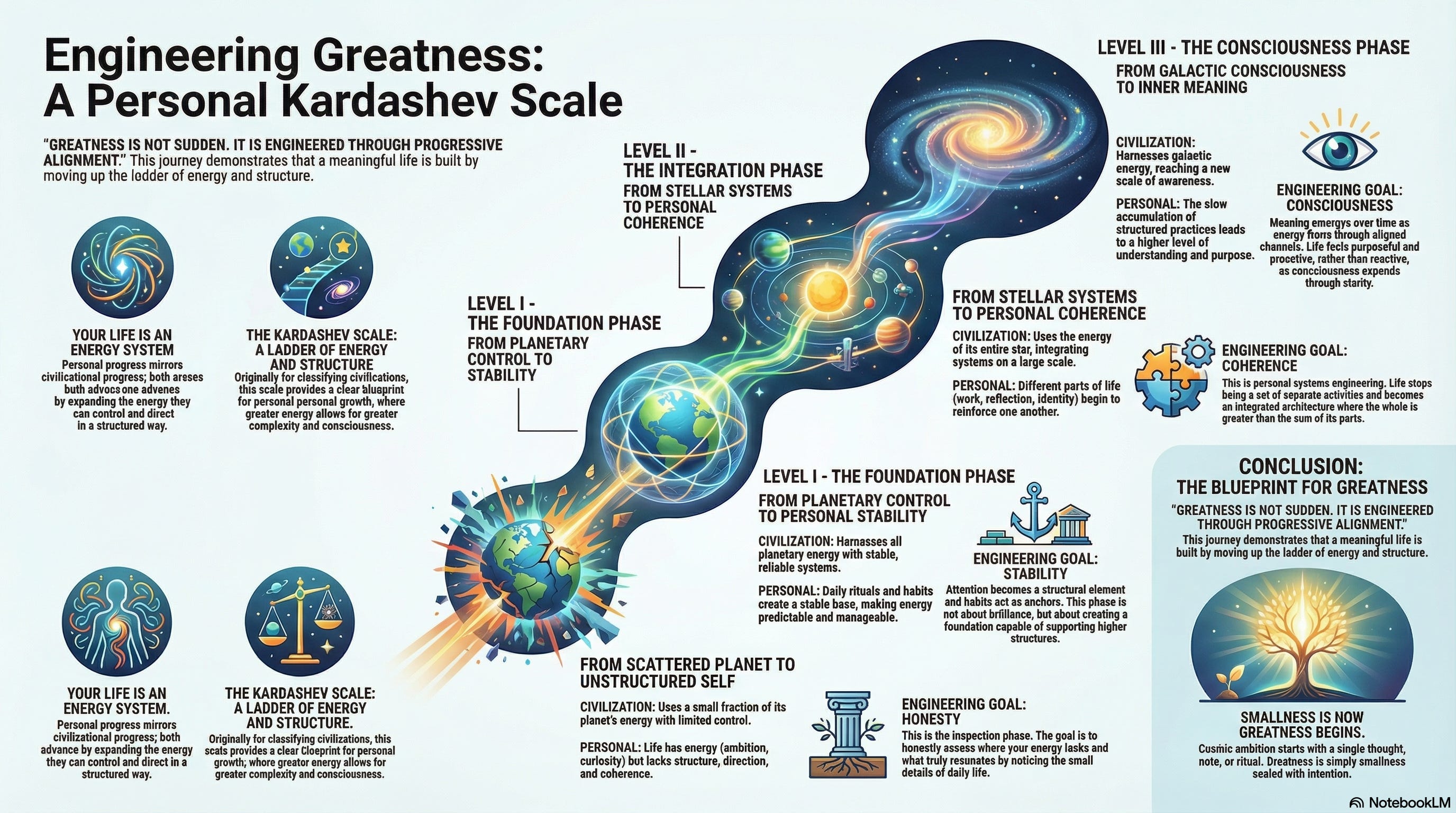
Type 0.7: The Original Meaning and My Interpretation
Original meaning
A Type 0 civilization uses only a small fraction of planetary energy. It is full of potential but lacks coherence. Energy leaks everywhere. Systems are reactive rather than intentional.
My interpretation
This describes the period before I started practicing the ten steps in Essay 1. I had curiosity and motivation, but my attention was scattered. My thoughts had the structural integrity of a bookshelf assembled without instructions. Everything stood up, but only just.
This stage mirrors what Musk might call the pre-foundation stage. Before a civilization builds satellites, it must stop wasting energy. Before a person builds meaning, they must learn how their attention actually behaves.
The practices from Essay 1 served as my Type 0.7 inspection. I learned what distracted me. I learned how my environment shaped me. I learned which moments carried weight. I discovered where my internal energy leaked into noise.
Every engineering project begins with an assessment. Type 0.7 is simply noticing that the bathroom door is in the wrong place before you pour the concrete.
Type I: The Original Meaning and My Interpretation
Original meaning
A Type I civilization captures all the energy available on its home planet. Its systems become stable. Its weather becomes predictable. It can rely on its own infrastructure.
My interpretation
This was the foundation phase of my blueprint. My morning latte ritual became a reliable base-load generator. Capturing what resonated became structural reinforcement. Reviewing notes from yesterday created continuity. Step by step, energy became stable.
Nothing exotic. Nothing cosmic. Just small, repeatable habits that allowed me to channel my attention instead of letting it scatter. This is exactly what a civil engineer seeks when stabilizing a foundation. Once the base is solid, the building can rise.
Type I represents stability. Without it, no further development is possible. Even the Romans would agree. A soldier cannot fight well if he is still struggling with his armor.
Type II: The Original Meaning and My Interpretation
Original meaning
A Type II civilization harnesses the energy of its star. It integrates multiple systems into a single coherent architecture. Its strength is unity of design.
My interpretation
This was the stage when my writing, reflection, advisory conversations and identity stopped being separate activities. They became parts of one structure. Writing supported reflection. Reflection shaped identity. Identity shaped practice. Practice strengthened clarity.
It felt like watching beams, columns and floors snap into place. The building became real. My life no longer felt like several parallel tracks. It felt like a single engineered system.
Musk would call this convergence. He sees SpaceX, Tesla and xAI eventually forming a single vision. I see my own writing, reflecting and living forming the same.
Type II is the stage where everything begins to reinforce everything else.
Type III: The Original Meaning and My Interpretation
Original meaning
A Type III civilization harnesses the energy of an entire galaxy. Its awareness expands on a scale that defies imagination. It becomes capable of understanding systems far larger than itself.
My interpretation
This is the stage where meaning begins to appear naturally. It is not forced. It emerges because the structure beneath it is strong. My small notes accumulated. My reflections connected. My insights aligned. Eventually, a sense of direction appeared that felt both surprising and inevitable.
This is not cosmic. It is personal. It is the moment when consciousness expands just enough to reveal the underlying architecture of your own life. You finally understand the shape of the structure you have been building for years.
Type III is energy expressing itself as clarity.
What the Kardashev Lens Revealed
The more I reflected on the Musk interview, the more the Kardashev Scale clarified my own blueprint.
Type 0.7 reminded me to be honest.
Type I reminded me to build a stable base.
Type II reminded me to integrate my systems.
Type III reminded me to let understanding emerge over time.
Greatness is not a heroic leap. It is an energy system learning to align itself. It begins with a small daily ritual. It ends with a structured sense of purpose. Much like civilization, a life becomes meaningful when it learns to harness the energy it already possesses.
In other words, greatness starts small.
And it scales.
Just like everything else in engineering.
Closing Reflection
The Roman skirt joke was not only funny. It was a reminder that even the most powerful systems must begin with practicality. Musk approaches everything from first principles. I discovered that I must approach my own life the same way.
Before building upward, I needed to understand my energy. Before scaling meaning, I needed to construct stability. Before reaching any sense of consciousness, I needed systems that reinforced each other.
The Kardashev Scale simply gave me a way to recognize that my daily practices had always been part of a larger architecture. Energy. Structure. Integration. Awareness. The blueprint continues to rise.
In the next essay, I will extend the engineering analogy by exploring load paths, damping, stress distribution and iterative design. These concepts may sound technical, but they have direct relevance to how we manage stress, adapt to change and reinforce meaning.
Until then, enjoy your coffee. And remember that even galaxies have to start somewhere.