
This Has Very Little to Do with France
Before the Tour’s Grand Départ, I Rehearsed My Own Return

A Beginning So Obvious It Became Suspicious
When we first planned our Southern France self-drive trip, Paris seemed like the natural starting point.
It was almost too obvious to explain.
If the journey is about France, begin in France. If the road will eventually lead through Provence, old towns, Roman stones, Mediterranean light, cafés, vineyards, and villages, then Paris gives the itinerary a respectable first line.
Fly in.
Pick up the car.
Begin from the capital.
Let the map behave.
Famous last words.
Maps rarely behave. They pretend to be instruments of order, but deep down they are novelists with a taste for plot twists. Give them one clean plan, and they quietly start working on character development, emotional reversals, and a surprisingly inconvenient third act.
Our first assumption was simple: start in Paris because it made logistical sense.
Then the route changed.
Earlier this summer, while traveling with our big family, I realized that our own planned trip would happen almost at the same time as the start of the 2026 Tour de France.
And this year, the Tour begins in Barcelona.
A French race beginning outside France first sounded like a interesting logistical fact. Then it became a symbolic invitation.
If the Tour de France could begin in Catalonia, why couldn’t our France road journey begin there too?
Paris had been the efficient answer.
Barcelona became the meaningful one.
Efficiency is a fine virtue. It keeps trains moving, bills paid, and suitcase weight just shy of offending the airline. But efficiency is not always the same as readiness. Sometimes the best beginning is not the one that gets you into the destination fastest.
Sometimes it is the one that prepares you to arrive better.
So we changed the entry city.
Naturally, the itinerary immediately created a problem.
Travel has manners like that.
You change it.
It replies.
The First Bill for Changing the Plan
Because Barcelona was not our original starting point, we missed the online ticket window for the Sagrada Família.
This may sound like a small logistical error. In ordinary travel, missing one ticket is not the end of civilization.
But for me, this one mattered.
To visit Barcelona and not step inside the Sagrada Família would have been a huge disappointment. It would be like ordering coffee and receiving only the sleeve. The cup is technically nearby, but spiritually, something has gone wrong.
The Sagrada Família is not only a landmark.
It is a building still becoming itself.
That matters to me.
Because Koffeemocha is also still under construction.
Not abandoned.
Not finished.
Still becoming.
A completed monument asks to be admired. An unfinished one asks to be accompanied.
A completed thing says, “Look what has been done.”
An unfinished thing says, “Look what is still being carried forward.”
That is a more vulnerable kind of beauty.
It also feels familiar.
I am not returning to Koffeemocha with a perfect declaration, a finished theory, or a banner that says, “Permanent Wisdom Now Available.” I am returning with scaffolding still visible. Some beams are in place. Some edges remain rough. A few mysterious cables are probably important, though no one has yet explained them.
In other words: a living project.
The Sagrada Família gave me a physical image for that condition. It stands not because it is finished, but because generation after generation has continued to build, revise, protect, and carry it forward.
For a personal project returning after a long silence, that is not a bad model.
The Ticket That Opened the Journey
On our first day in Barcelona, we walked into the tourist center almost by chance.
We were not executing a perfect plan. We were arriving, adjusting, walking, trying to understand the city at the speed our tired bodies could afford.
There is always a gap between the elegant itinerary on paper and the actual human beings carrying backpacks in warm weather.
The paper itinerary is always more athletic than the traveler.
Then, unexpectedly, we got the tickets in person.
A door I thought had closed opened again.
The plan did not win. Reality won.
But this time, reality was kind enough not to smirk.
That moment changed the meaning of the first day. It was no longer only about getting into the Sagrada Família. It was about learning how this journey would have to work.
The itinerary could not be treated as a contract.
It had to be treated as a draft.
A contract punishes deviation.
A draft invites revision.
That became Barcelona’s first lesson.
The old plan said: begin in Paris because it is obvious.
Barcelona replied: the obvious beginning is not always the truest one.
The old plan said: secure every important detail before arrival.
Barcelona replied: leave enough margin for the city to participate. It has opinions too.
The old plan said: missing the online ticket is a failure.
Barcelona replied: sometimes a hole in the plan lets in a better story.
This is not an argument against planning. I still believe in planning. My temperament includes a trained engineer who likes routes, timings, reservations, backup options, and the quiet moral dignity of a well-labeled folder.
Civilization was not built by “let’s just see what happens.”
But travel exposes the difference between planning and control.
Planning prepares you to meet reality.
Control pretends reality has already signed the form.
On the first day in Barcelona, reality did not destroy the plan.
It edited the plan.
And because we were willing to treat the itinerary as a draft, the edit became a gift.
The Second Edit: Your Battery Level Is Part of the Itinerary
On the second day, Barcelona continued its editorial work.
We woke later than expected.
Breakfast moved later. The route changed. The afternoon heat was not theoretical. It was not one of those neat little numbers on a weather app, polite and harmless behind glass.
The heat had a body.
It entered our bodies and demanded respect.
So we returned to the hotel to rest, then went out again later.
Under my older, more ambitious style of travel, I might have judged this as a loss.
We saw less.
We completed fewer items.
The checklist looked less triumphant.
I imagine the checklist was disappointed in us. It had dressed for victory.
But because of that adjustment, the day actually became better.
We began to admit something simple and important:
Your battery level is part of the itinerary.
Not a footnote.
Not an excuse.
Not a moral failure hiding behind the phrase “we’ll take it easy.”
Energy is infrastructure.
A journey is not only made of cities and landmarks. It is made of sleep, digestion, shoes, temperature, appetite, mood, attention, and the fragile diplomacy between ambition and the body.
This sounds obvious. But obvious truths often arrive late, dragging an overweight suitcase behind them.
Barcelona was teaching us that a good route is not the one that contains the most places.
It is the one that leaves you alive enough to receive them.
This is a humbler travel philosophy.
It may also be a wiser one.
As a bonus, it is much better for naps.
The Third Edit: How Am I Seeing?
On the third day, we went to the Sagrada Família.
This time, the lesson was not logistical. It was visual, almost spiritual.
From late afternoon toward evening, the stained glass slowly transformed the interior. The light did not merely decorate the church. It measured time. It gave time color, temperature, and direction.
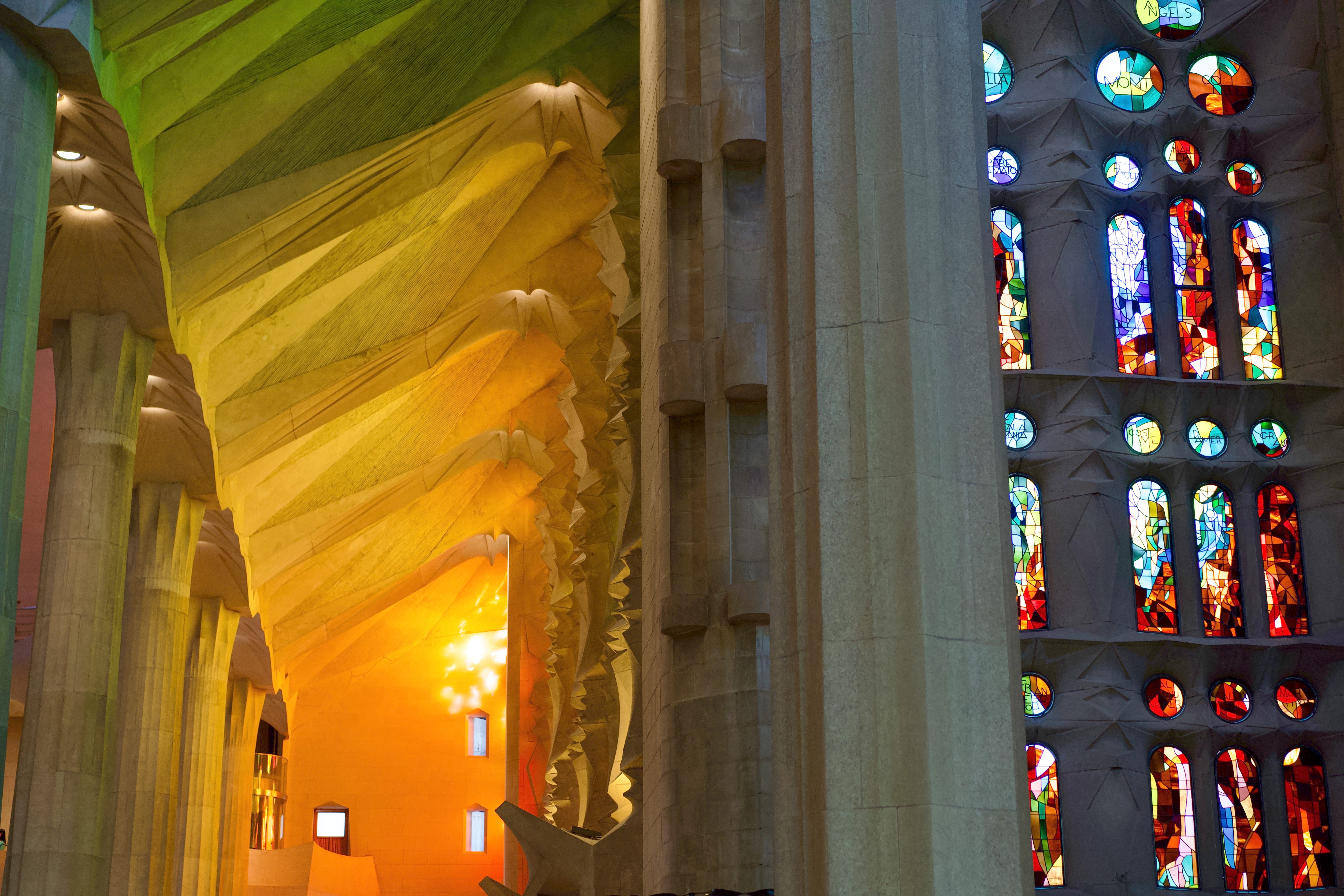
Time, for once, stopped pretending to be abstract.
It showed its face.
We were not simply standing inside a famous landmark.
We were being adjusted by a space.
This is when travel becomes useful.
If travel only helps us say, “I was there,” that is already something.
If it helps us say, “I saw this,” that is better.
But when it forces us to ask, “How am I seeing?” — then it becomes important.
A landmark can become a trophy. A photograph can become evidence. A famous building can become another box checked off with the grim efficiency of tax paperwork.
But the Sagrada Família resisted that.
It did not want to be consumed quickly. It slowed the eye. It turned attention from possession into participation.
That question matters for Koffeemocha’s return.
The next stage of this work cannot only be about where I go or what I think. It has to be about whether the road changes how I notice, judge, recover, and act.
Reflection alone is not enough.
A beautiful thought eventually has to meet a real street.
Preferably in comfortable shoes.
A Dress Rehearsal for Departure
By the fourth day, the method became more practical.
We did not begin the day by rushing to another landmark.
Instead, we rehearsed tomorrow.
This may sound slightly neurotic. But once tomorrow becomes less frightening, it stops being neurotic and starts looking suspiciously like maturity.
Or at least a sincere attempt at maturity.
From the hotel, we took L3 to Barcelona Sants, the station we would need on July 3 when leaving Barcelona. Then we changed to L5 toward Sant Pau, the starting area for the Tour de France team presentation route.
It was a small act.
Almost too ordinary to mention.
But it changed the whole day.
In travel, safety does not come from controlling everything. It comes from testing the critical path early enough that anxiety has time to dissolve.
Barcelona Sants was no longer tomorrow morning’s unknown system. It became a place the body had already entered.
The route was no longer an abstraction. It had been walked, transferred, timed, and felt.
A station becomes much less intimidating after your shoes have already negotiated with it.
That was when I understood why Barcelona had become the right starting point.
If we had begun in Paris, I might have entered France too quickly and mistaken arrival for readiness.
Barcelona slowed the story down just enough for me to see the hidden work before departure.
The real beginning was not the first border crossing.
It was the first rehearsal.
A Sandwich, a Nap, and a Yellow Jersey
At noon, we did not search for another restaurant.
My wife bought Iberian ham and multigrain bread from Carrefour. We returned to the hotel and made simple sandwiches.
After several days of restaurant meals, that lunch tasted unusually good.
It had no ceremony, but it had recovery.
Then I slept for one hour.
A younger version of me might have considered this unambitious.
When I woke, the room was quiet. My phone was charging. The Tour de France event package was nearby.
I put on the yellow jersey and prepared to finish this essay before walking toward the Sagrada Família for the team presentation.
Wearing yellow before a Tour de France event is a bold gesture for a man whose major athletic accomplishment that day was successfully changing metro lines and respecting lunch.
Still, it felt right.
That was when the truth of the day became clear.
The best part had not been waiting for the evening event.
It had already begun.
It began with the rehearsal to Sants.
It began with the transfer to Sant Pau.
It began with seeing the barricades and police vehicles near the red-brick modernist buildings.
It began with the ham sandwich.
It began with the nap.
It began when I put on yellow and prepared to walk into the crowd.
I had thought the team presentation would give me a good moment to write about my return.
Barcelona gave me something better.
It gave me a way to practice returning.
The Team Presentation
The official reason to be in Barcelona on July 2 was the Tour de France team presentation.
Barcelona’s Grand Départ ceremony links the Recinte Modernista de Sant Pau and the Sagrada Família, and the official Tour schedule places the team presentation at the Sagrada Família on Thursday, July 2, beginning at 6:30 p.m. The race itself begins on July 4, with Stage 1 in Barcelona as a 19.6 km team time trial. (Tour de France™’26)
But the presentation already changes the atmosphere.
No one wins the Tour de France by standing on a stage.
Fortunately for human civilization, speeches still do not count as watts.
But the ceremony matters because it turns private preparation into public commitment.
The riders are named.
The teams appear.
The city begins to cheer.
The race has not started, but something irreversible has begun.
That is what I wanted for Koffeemocha too.
Not a performance.
Not a victory speech.
Not me standing dramatically on a balcony announcing a new era while pigeons continue their ancient policy of indifference.
Something humbler.
A re-presentation.
A way to step back into public view, not to claim the work is finished, but to admit that it is ready to move again.
There is humility in a team presentation. Each rider appears before the crowd, but no rider appears alone. Behind every visible cyclist is a whole invisible system: mechanics, directors, nutritionists, route planners, equipment managers, trainers, sponsors, sacrifice, and probably several people whose sacred duty is to remind him to eat at the correct time.
The bike may look individual.
The race never is.
That matters to me.
A personal journey is never purely personal either. It depends on family, health, money, readers, memory, weather, maps, meals, and the patience of people who agree not to ask why you are taking notes about a sandwich.
The visible journey always rests on invisible systems.
Koffeemocha’s return needs the same honesty.
Not just inspiration.
Support.
Not just meaning.
Rhythm.
Not just a grand idea.
A route that can actually be walked.
Why Barcelona, Not France?
Now I can answer the question more honestly.
Why begin a France journey in Barcelona?
Not because Barcelona is more convenient than Paris.
It is not.
Not because Spain is a substitute for France.
It is not.
Not because the plan became smoother.
It absolutely did not.
I chose Barcelona because the original plan had become too narrow.
Paris would have started the trip efficiently.
Barcelona helped me start it truthfully.
If we had begun in France, the journey might have moved too quickly into destination. Barcelona forced us to begin with departure itself: the missed ticket, the crowded opening, the adjusted pace, the protected afternoon, the tested route, and the quiet preparations that actually determine the quality of a journey.
It showed me that the true beginning of a trip does not always happen at the border of the destination.
Sometimes everything has to begin just outside it.
The traveler must first learn how to become ready.
The Tour de France calls it the Grand Départ.
For me, it became a quieter grand departure.
Not grand because it was spectacular.
Grand because it was honest.
Apparently, the road was a better editor than I was.
The Practice Beyond Reflection
This is what I want to carry back into Koffeemocha now.
A return should not only be announced.
It should be tested.
A new beginning should not only be described.
It should be rehearsed under ordinary pressure: heat, crowds, transit, timing, fatigue, appetite, missed tickets, small decisions, and the humility to revise.
This is the practice beyond reflection.
Treat the itinerary as a draft.
Test the critical path.
Protect the body.
Accept the city’s edits.
Let reality participate.
Then walk into the public square.
For now, this has very little to do with France.
France is still ahead.
It is still the landscape, the destination, the pleasure, the history, the cafés, the villages, the cathedrals, and the endless negotiation between map and appetite.
But Barcelona became the threshold.
The Sagrada Família reminded me that unfinished work can still be sacred.
The Tour de France team presentation reminded me that preparation eventually has to become visible.
And the first four days reminded me that a journey becomes useful only when it changes how we move.
I did not choose Barcelona because it was the most logical way to start a France drive.
I chose it because the journey had already begun shaping me.
So yes, I came to Barcelona to watch a team presentation.
But more accurately, I came to re-present my own return.
Not through a manifesto.
Not through a slogan.
Not through another grand and safe reflection from a comfortable chair.
But through a tested route.
A protected afternoon.
A simple lunch.
One hour of sleep.
A yellow jersey.
And the step into the crowd.
That is what I mean when I say the journey has begun.
France is ahead.
But this chapter is about departure.
Kefei, Barcelona
July 2, 2026