
You Can’t Enter a Moving Glacier Through the Same Entrance Forever
At the Mer de Glace, an eighty-year tradition continues by carving a new way into the ice each season. Continuity sometimes asks the same of us.

My previous letter from France ended in Toulouse, where the city booted up at nine at night and the itinerary quietly surrendered some of its authority. Heat, fatigue, and a necessary afternoon nap had already taught us that freedom needs rhythm. As we continued east, that lesson stopped being merely an observation and became the way we traveled.
The unusual July heat in France began revising the route before I did. We responded by moving toward higher elevations in the Alps, and by July 11 we had arrived in Chamonix. We were looking first for cooler air, not for the image that would eventually explain the journey.
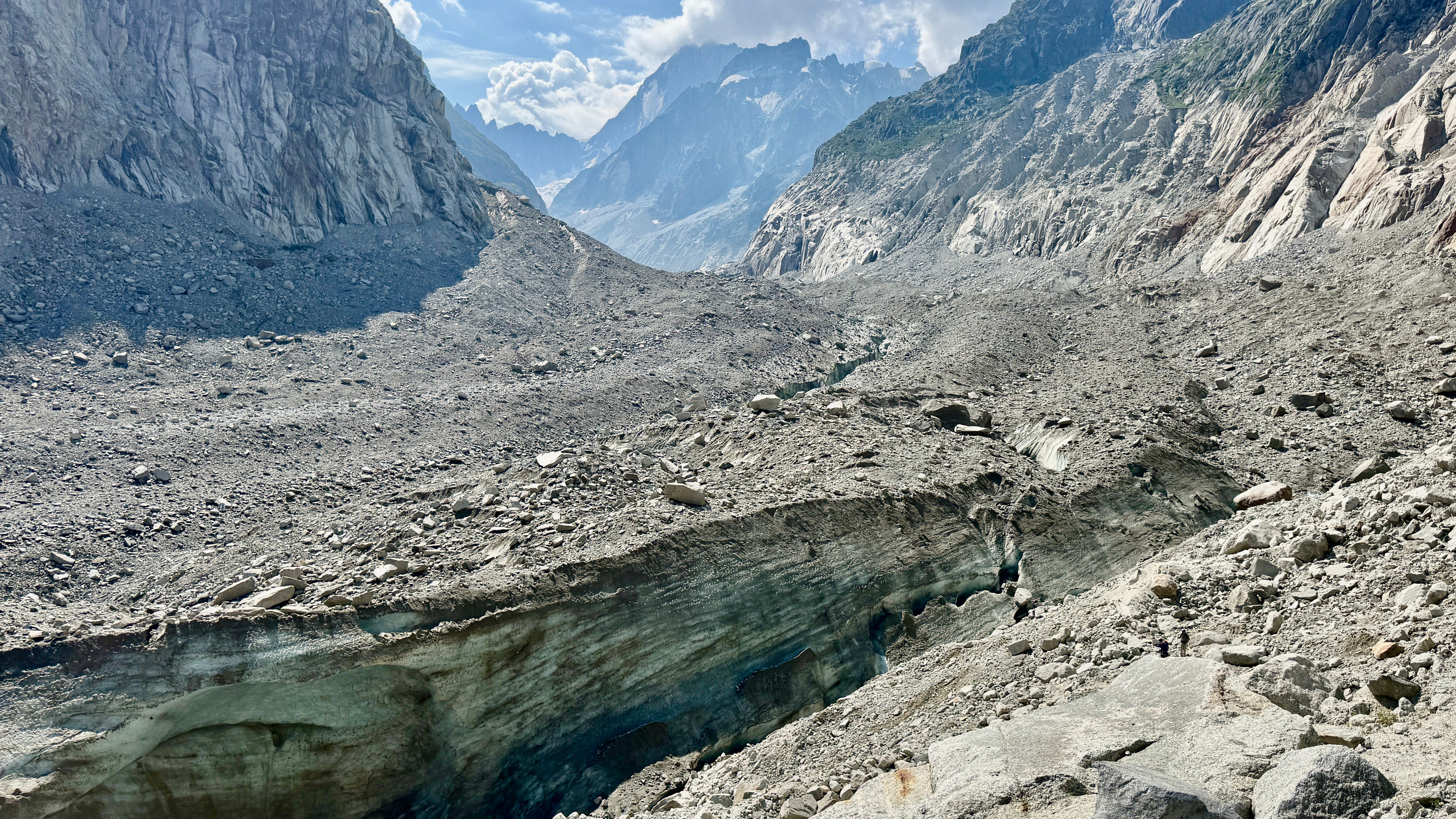
From Chamonix, we boarded the little red cogwheel train to Montenvers. It climbed steadily out of the valley and brought us to a platform overlooking the Mer de Glace, with the jagged granite forms of the Mont Blanc massif rising around it. From a distance, the glacier looked immense and almost permanent.
When we descended toward the ice cave by gondola, I expected ice, mountain scale, and perhaps the clean blue opening of a natural chamber. Instead, the approach led between metal railings and heavy machinery toward a small dark entrance beneath an eightieth-anniversary sign. Broad white protective sheets covered much of the ice above it, and the whole place seemed less like a timeless natural wonder than a seasonal worksite newly prepared for visitors.
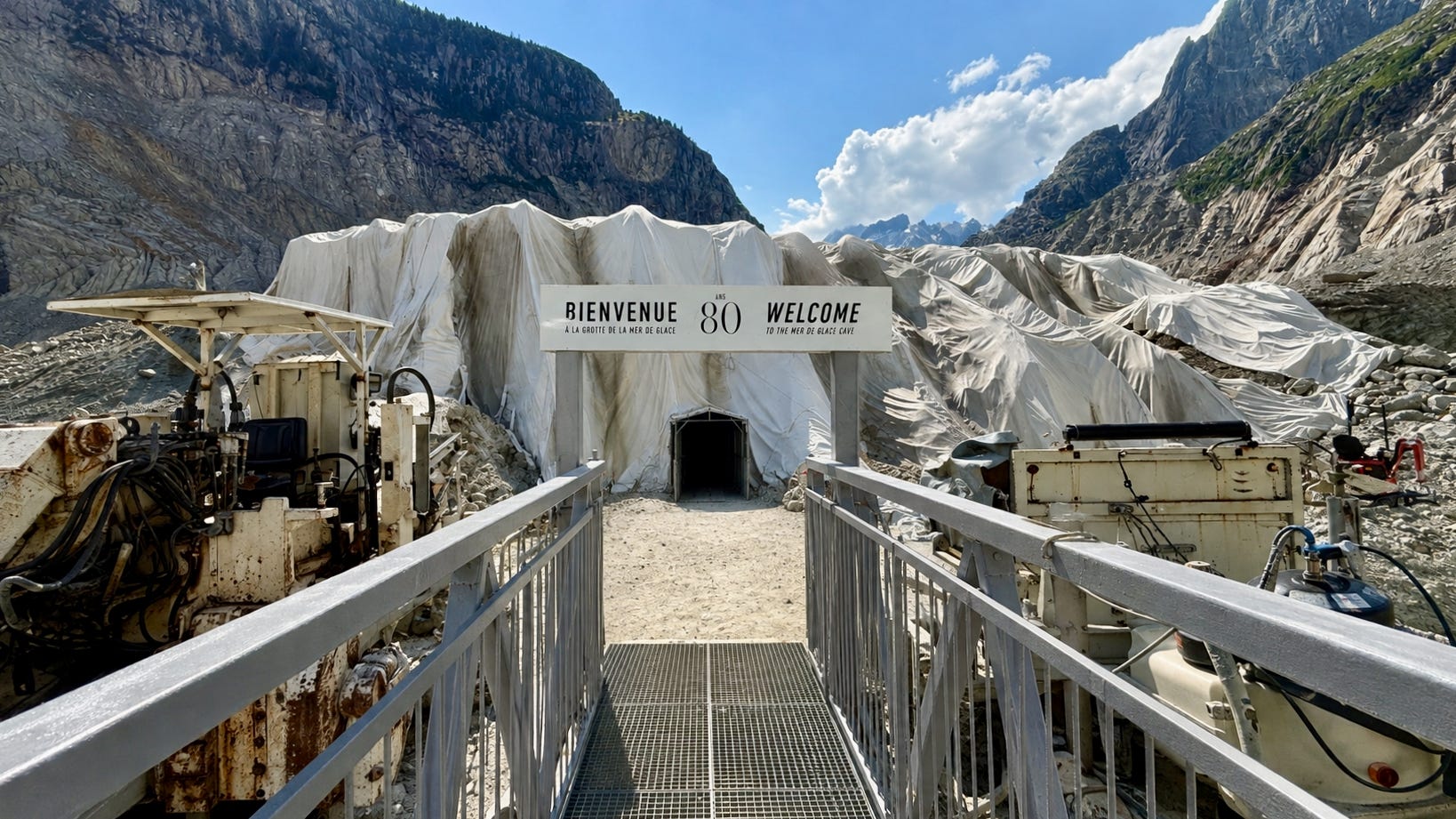
At first, the machinery and coverings appeared to interrupt the beauty. Then they became the point. The visitor cave was not preserved from one year to the next; a new way into the ice had to be carved each season because the glacier carrying it continued to move, melt, and change shape.
The glacier is not still. It flows, thins, retreats, and changes position, even when its movement is too slow for us to perceive during a single afternoon. Stand there for a few hours and you see a landscape; stretch the timescale and you see a process.
That distinction matters because a snapshot is very good at disguising movement as stability. Looking only at the present, I might say, “The glacier is there.” A more accurate sentence would be: The glacier is there right now.
What we saw was not an eternally fixed glacier. It was one version of the glacier in the middle of a long movement. Perhaps I will return in five years, follow another route downward, and discover that the ice has moved farther away.
Perhaps I will never return. What made the moment precious was not simply that I had seen “the glacier,” but that I had been allowed to see what the glacier looked like now. The place was real, immense, and already changing.
That contradiction became the central image I brought home from France. Continuity does not always mean preserving the shape that worked before. Sometimes the purpose remains, the conditions change, and the old entrance no longer reaches the living thing.
The Tradition Continues. The Entrance Does Not.
Visitors follow the route downward and enter a tunnel carved directly into the body of the glacier. Inside, the walls glow blue, creating the illusion that the cave has always been there, patiently waiting to be discovered.
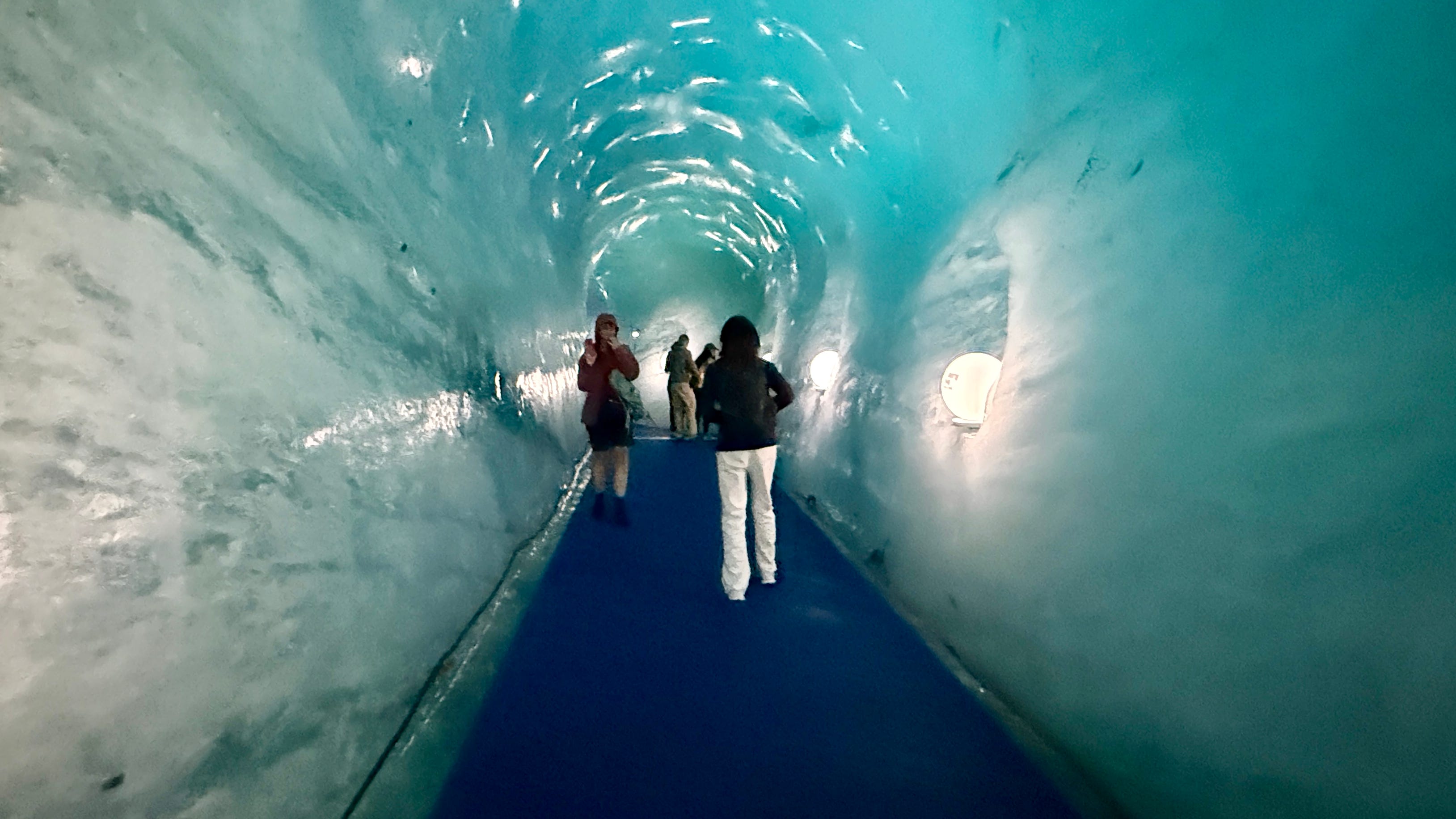
It has not. The entrance, passage, and interior are temporary responses to the glacier’s present position. What feels stable during a visitor’s brief walk through the ice is already part of something moving.
In 1946, Georges Claret began carving a visitor cave into the Mer de Glace. Three generations of the Claret family have continued the work, and the people who practice this unusual craft are known locally as the grottus. In 2026, the family tradition reached its eightieth anniversary.
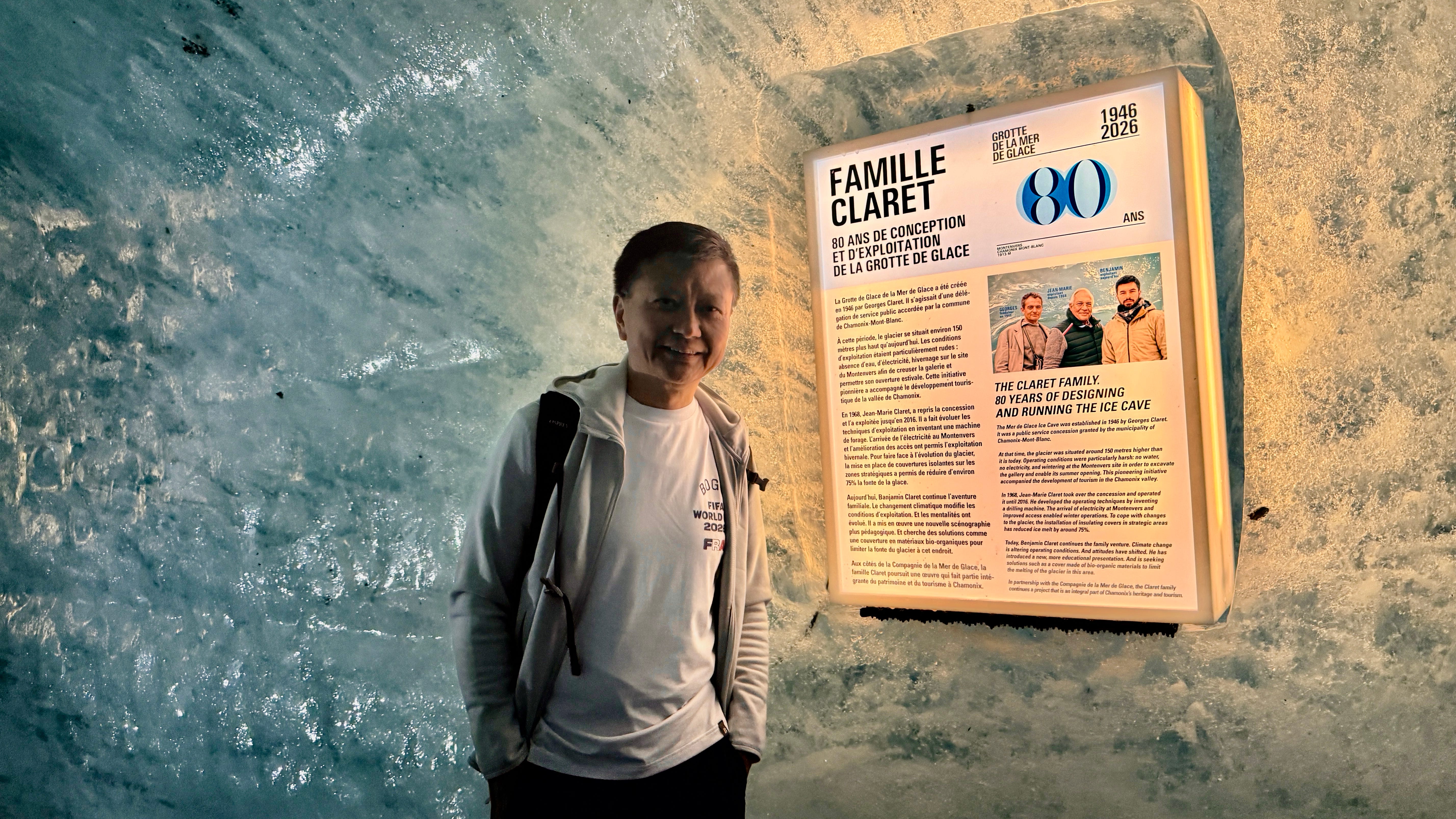
That fact made me stop. This is a tradition that has continued for eighty years, yet each particular cave usually lasts only one season. The tradition continues. The entrance does not.
Every year, the people responsible for the cave must look again at where the glacier has moved. They must understand its new position, bring their tools, and cut another way in. Their task is not to restore last year’s tunnel as though nothing has changed.
They preserve continuity by releasing their attachment to the previous form. The cave continues not because it remains in one place, but because someone keeps noticing where the glacier has moved and finds an entrance there.
This is a different kind of longevity. It is not permanence of form, but continuity of intention, craft, and judgment. The shape changes because the tradition is still alive.
Visitors see blue ice, mountain peaks, and a magical passage into the glacier. They may not see the railway, gondola, stairs, safety inspections, glacier monitoring, machinery, seasonal workers, or the judgment accumulated across three generations of one family. The visible experience depends on an enormous amount of largely invisible maintenance.
Continuity does not happen automatically. It has to be maintained, and when the thing being maintained is itself moving, maintenance cannot mean repetition. It must include observation, judgment, and redesign.
In Toulouse, I had written a sentence: Beauty is infrastructure. At the Mer de Glace, I saw the other half of it: if beauty is moving, its infrastructure must learn to move too. Some maintenance is innovation without a launch event or applause.
The Plan Met the Road
Before leaving New York, I imagined that Koffeemocha would restart along with the turning wheels. After six quiet months, I had published Before Departure: When Travel Becomes Practice, followed by This Has Very Little to Do with France, and then a letter from Toulouse on July 4. I expected the journey ahead to turn that return into a regular rhythm.
Each day, I would see something, think about it, write a short field note, and publish it. The road would provide the material, and the hotel room would become a temporary writing studio. See. Think. Publish. Sleep. Then do it again the next day.
It was a clean and elegant little system, with a pleasing amount of engineering logic. I had also quietly asked that system to prove something: that my return to writing was real. France, drawing on several thousand years of practiced composure, politely but firmly declined to participate.
The problem was not simply fatigue. It was the cumulative load of each day, and the heat was enthusiastic too. It rarely missed a day.
Driving required concentration, while parking required patience. Leave a little later in the morning and the afternoon schedule shifted with you. Let lunch run a little long and the museum visit began quietly shrinking.
A beautiful village in a photograph usually arrived in real life with a complimentary set of stairs. A road that looked short on the map might require an hour of complete attention. The map tended to remain silent about this because it reports distance, not stamina.
By the time we returned to the hotel, the body had usually resigned from the literary committee. It did not wish to discuss structure, metaphor, or endings. It wanted water, shade, and the restoration of normal diplomatic relations with the air conditioner.
My calendar might still have contained an hour labeled “writing,” but a calendar hour and a usable writing hour were not the same thing. The work first took the form of driving, walking, changing plans, accompanying family, watching cities, and admitting at the end of the day that I was genuinely tired. Some work is written first, while some has to be lived first. This essay belonged to the second kind.
Before departure, I had given my daily planning check a private engineering name: Daily Trip Load Path, or DTLP. In structural engineering, a load path describes the route by which forces travel through a structure and ultimately reach the ground. On the road, I used the term to ask a more human question: What would this day require the two of us to carry, and where would that load fall?
The load of a travel day includes far more than the number of miles to drive. It includes heat, walking, transfers, reservations, uncertain parking, and the small negotiations required when two people’s energy levels are not perfectly synchronized. Some loads appear clearly on the itinerary, while others reveal themselves only after the day has begun.
Each morning, and sometimes again during the day, I rechecked the route. What had changed in the weather? How much energy did we actually have? Which part of the plan carried the meaning of the day, and which part was merely optional?
One afternoon, Sharon wanted to continue browsing a market while I needed to sit down. Instead of forcing both of us through the same sequence, we separated for an hour. She kept exploring, I recovered, and afterward we continued together with more patience than the original plan would have left us.
Nothing dramatic happened, which was precisely the point. A small adjustment prevented a manageable difference in energy from becoming unnecessary pressure. The plan changed, but the day remained intact.
I gradually understood that an itinerary is not a contract. It is a draft still under revision. Its value depends not on how faithfully we obey it, but on how intelligently it helps us respond when reality changes.
DTLP worked remarkably well, just not in the way I had first imagined. It did not produce a daily essay. It produced better decisions.
It gave us room to browse markets, take naps, eat later, choose another road, and move toward higher elevations during extreme heat. Sometimes it helped us release one destination so that another could still be experienced properly. It helped us remove part of the load before the load damaged the structure.
That may have been the more important result. The real value of a workflow is not that it protects the original plan. It protects the people trying to carry it out.
A Position Is Only One Entrance
Once I began seeing an entrance as temporary, it became difficult not to see a job position in the same way. We often speak about work in the grammar of permanence: my company, my title, my office, my profession, my salary. Those possessives sound reassuringly solid, almost as though they had already been entered on a property deed.
A position exists because several conditions temporarily align. Customers still need the work, the organization is willing to fund it, technology still allows it to continue in its present form, and the people involved remain able to support it. From inside the position, those conditions may feel like bedrock when they may only be moving slowly enough to appear still.
AI is accelerating some of that movement. The first changes may not appear in the job title itself, but in the cost of a task, the speed of delivery, the boundary of a role, and the value assigned to human judgment. A title can remain unchanged even while the load path beneath it has already shifted.
The useful question, then, is not only, “Is my job safe?” It is also worth asking what conditions allow the position to exist, which of those conditions are changing, and which capabilities truly belong to the person rather than only to the organization.
If one entrance can no longer be used, what can still be carried toward the next one?
I no longer calculate structural loads for airports and high-rise buildings. Yet the habit of asking what is carrying the load, where margin is needed, what can be removed, and how a structure will respond when conditions change did not remain behind in that profession. That judgment followed me into technology management, travel, writing, and my understanding of transition.
The Claret family does not carry last summer’s cave into this year’s glacier. The old cave has already completed its purpose, giving visitors a way into the ice and giving the craftspeople experience they can use again. The tunnel disappears, but the judgment can be carried forward.
We do not begin every transition from zero. We arrive with tools, habits, experience, and accumulated judgment. The next entrance may be new, but the person holding the tools is not empty-handed.
The Tools Remain
Before departure, I thought returning to Koffeemocha meant publishing more frequently. France recalibrated that measure. A recovered cadence may be evidence of continuity, but it is not continuity itself.
Regular publishing had been one entrance into the work. When that entrance no longer matched the conditions of the journey, standing beside it and trying harder would not have brought me closer to the experience. The writing would have to return by another route.
Koffeemocha’s continuation does not mean waiting for life to become what it was before. It means carrying forward the judgment that still matters, noticing what has moved, and finding the next workable way in. The purpose can remain steady even when the form has to change.
The glacier has moved, and so have I. The old entrance is gone, but the tools remain.
Kefei
New York City